
 By rosebell
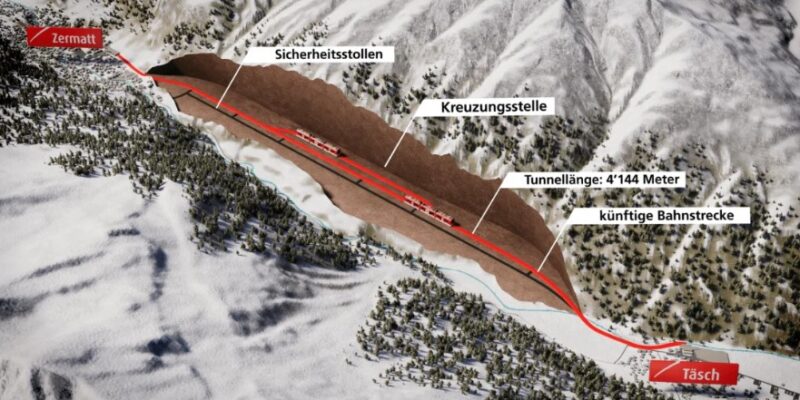
The 4.141 km railway tunnel is being developed by Matterhorn Gotthard Bahn to provide a safer and more reliable year-round connection to Zermatt, replacing the existing exposed railway alignment through the Matter Valley. The present line is vulnerable to avalanches, rockfalls and landslides, which can cause interruptions to one of Switzerland’s busiest single-track railway routes.
The project is part of Switzerland’s STEP 2035 Strategic Development Programme for Railway Infrastructure and represents the largest investment project currently being undertaken by Matterhorn Gotthard Bahn. The Federal Office of Transport is responsible for the federal railway infrastructure programme through which the scheme is being funded.
The importance of the route is considerable. Up to 200 trains operate between Täsch and Zermatt each day and the railway carries more than 4.4 million passengers annually. The new tunnel is intended not only to protect this connection from natural hazards but also to substantially improve capacity, journey times and timetable reliability.
The proposed railway tunnel will be predominantly single track, incorporating a 1.4 km double-track passing section. A parallel safety tunnel will run alongside the main railway tunnel, with cross passages between the two approximately every 500 m.
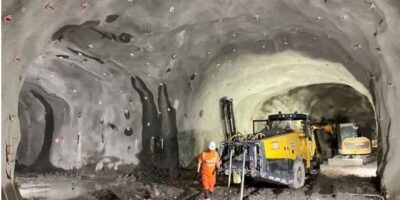
Both the main railway tunnel and safety tunnel are planned to be excavated by drill-and-blast methods west of the Matter Vispa.
A major advantage of the new alignment will be its considerably more consistent gradient. At a maximum or design gradient of approximately 38.5‰, the new railway will no longer require the rack-and-pinion system used on the existing steep alignment. This will allow trains to operate at higher speeds and reduce the Täsch-Zermatt journey from around 12 minutes to approximately six to seven minutes.
The shorter journey and improved operational reliability will support a 15-minute shuttle frequency between Täsch and Zermatt, compared with the present 20-minute service, as well as a regular 30-minute service between Visp and Zermatt.
From Täsch, the new railway will leave the existing alignment on the western side of the valley. A new railway embankment and approximately 80 m long bridge will carry the line across the Matter Vispa before trains enter the new tunnel.
Additional protection against avalanches and rockfall will be provided around the Täsch portal, while the elevated railway alignment will contribute to flood protection. An extension of the double-track section approaching Täsch will allow trains up to 170 m long to pass without requiring major reconstruction of Täsch station.
At the northern end, the railway tunnel will connect with the existing Schafgraben gallery close to Zermatt station. A new double-track section in the approach to Zermatt will similarly accommodate the crossing of 170 m passenger trains, while connections will also be maintained with the Schafgraben freight facilities.
The parallel safety tunnel will connect with a separate access tunnel constructed from the Grüebe area. This access will also play an important role during construction.
The project extends beyond the two main underground excavations. The engineering works include the Täsch double-track extension, the new bridge across the Vispa, portal structures at Täsch and Zermatt and reconstruction of the Schafgraben gallery in Zermatt.
Planning has been undertaken by the IG HORU engineering consortium, comprising Rothpletz, Lienhard + Cie AG, Gähler und Partner AG and SPI Schmidhalter Partner Ingenieure AG. In addition to the principal civil engineering design, the consortium is responsible for much of the railway systems planning, including track, traction power, cabling, low-voltage systems, telecommunications and technical installations, together with planning for construction material management.
The project reached another major milestone at the end of June 2026 when Matterhorn Gotthard Bahn submitted the approval project to the Federal Office of Transport. The formal public period is scheduled to run from 31 August until 29 September 2026, allowing affected parties to examine the plans and submit objections.
Subject to the progress of the approval procedure, procurement is expected to begin during 2027. Matterhorn Gotthard Bahn anticipates receiving planning approval during 2028, after which the main construction programme can begin.
Initial works will include establishment of the Täsch construction site, construction of the Vispa railway bridge and preparation of the temporary and permanent railway infrastructure.
According to the current programme, excavation from the Täsch side is expected to begin in October 2029. Breakthrough of the safety tunnel is targeted for the end of 2030, followed by breakthrough of the main railway tunnel around September 2031.
Internal tunnel construction is scheduled to begin in spring 2032, with installation of railway systems following from spring 2034. Opening of the Mattertal Tunnel to passenger services is planned for 2035.
After commissioning, the existing exposed railway alignment will become redundant, with dismantling currently expected to take place between 2036 and 2038.
The current project cost estimate is approximately CHF471 million, although Matterhorn Gotthard Bahn notes that the figure remains subject to a potential variation of around plus or minus 20% as the project progresses through design and procurement.
For Zermatt and the wider Matter Valley, the project represents considerably more than a journey-time improvement. Moving almost the entire Täsch-Zermatt railway connection underground will provide substantially greater protection from the natural hazards that have repeatedly affected the existing route, while creating the infrastructure required for a faster and more frequent railway service.
With procurement expected to begin in 2027 and construction planned from 2028, the Mattertal Tunnel is also set to become an important upcoming opportunity for Switzerland’s tunnelling, underground construction and railway infrastructure sectors.