
 By rosebell
Caltrans has moved the Last Chance Grade Permanent Restoration Project into its design phase, advancing plans for an approximately 1.8 km (6,000 ft) highway tunnel that will bypass one of the most landslide-prone sections of U.S. Highway 101 on California’s North Coast.
The project in Del Norte County represents the permanent solution to decades of ground movement, emergency repairs and traffic restrictions along the Last Chance Grade section of U.S. 101 between Wilson Creek and Crescent City. The existing highway crosses an active landslide complex where continued instability has created a long-term threat to the only major north-south highway serving this part of the California coast.
Caltrans has now completed the Project Approval and Environmental Document phase, including publication of the Final Environmental Impact Report/Environmental Impact Statement and selection of Alternative F as the preferred scheme. The decision clears the project to proceed with final design, permitting, geotechnical investigation and right-of-way activities.
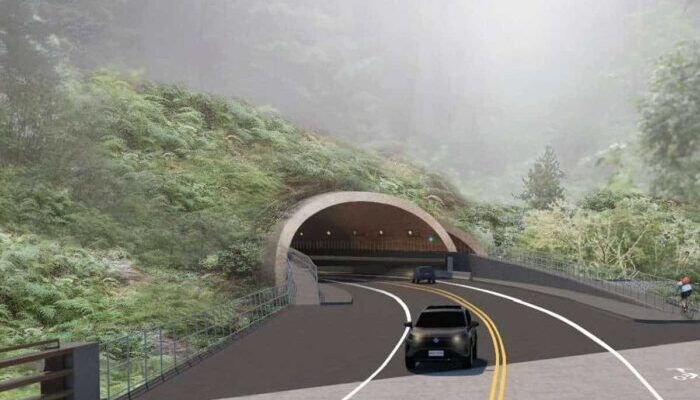
The selected alignment will move U.S. 101 east of the existing coastal highway and place approximately 6,000 ft of the route underground, avoiding most of the active landslide complex. The tunnel will accommodate one traffic lane in each direction, 8 ft shoulders and a separated facility for cyclists and pedestrians. An operations and maintenance center will also be constructed as part of the scheme.
At approximately 1.1 miles long, the new tunnel would become the longest highway tunnel constructed by Caltrans. It will be around 1,800 ft longer than each of the twin Tom Lantos Tunnels at Devil’s Slide, which were constructed between 2005 and 2013 to bypass another geologically unstable section of California’s coastal highway network.
The scale of the ground engineering challenge is considerable. The alignment passes through an area characterized by complex landslide processes, seismic risk and environmentally sensitive redwood forest. Caltrans’ environmental assessment concluded that the tunnel alternative offers substantially greater long-term resilience than rebuilding and stabilizing the existing highway alignment. A geotechnical risk assessment found the tunnel alternative approximately twice as likely to perform well as the competing re-engineered highway option, as well as providing greater resilience during major storms and earthquakes.
Detailed design will now further develop the tunnel portals, underground works, connecting highway, bridge structures, drainage, tunnel safety installations and operations and maintenance facilities. Further geotechnical investigations will also be undertaken to refine the geological model and identify unstable ground and subsurface slip planes along the proposed alignment.
Caltrans expects advanced underground construction technologies to form part of the project, including precision excavation systems, robotic shotcrete application and real-time monitoring intended to improve construction control while limiting disturbance at the surface.
The project is being developed using a Construction Manager/General Contractor delivery strategy. This will allow contractor involvement during design so that constructability, excavation methodology, construction sequencing, early works, cost estimates and potential programme savings can be considered before the main construction contract is agreed.
Caltrans has also sought specialist multidisciplinary engineering support covering geotechnical engineering, structural and roadway design, building facilities, BIM for infrastructure, materials engineering, environmental services, surveying, landscape architecture, constructability and project management. The scale and complexity of these requirements underline the significance of Last Chance Grade for the international tunnelling and underground construction supply chain.
Funding for the design stage has also moved forward significantly. The California Transportation Commission initially approved USD40 million in June 2025 to begin the Plans, Specifications and Estimates phase. Further funding has subsequently been approved, with current project material identifying approximately USD225 million for design and associated right-of-way activities.
The much larger challenge remains financing construction. Current estimates place construction at approximately USD2.5-3.5 billion, while the project’s Alternative F information gives a current construction estimate of around USD2.7 billion in 2026 dollars. Full construction funding has not yet been secured and Caltrans is expected to pursue a combination of state, federal and financing sources while detailed design progresses.
The investment is being driven by the strategic importance of U.S. 101 to Del Norte County. A major failure at Last Chance Grade could require motorists to make an approximately 449-mile detour through Oregon and inland Northern California, adding around eight hours to journeys. Such a closure would affect residents, freight transport, tourism, emergency services and access to education and healthcare.
The North Coast’s tourism economy is also closely tied to the highway. U.S. 101 provides access to Redwood National and State Parks and other coastal destinations that attract approximately 2.5 million visitors annually.
Environmental considerations will remain central during final design. The approved tunnel alternative substantially reduces exposure to the unstable surface corridor but will still affect sensitive forest habitat. Current project information identifies the loss of approximately 2.24 acres of late-successional forest habitat and 16 large redwood trees greater than 4 ft in diameter. Caltrans says opportunities to further reduce these impacts will be examined as design progresses, alongside investment in forest restoration.
The present programme places the project in design and permitting between 2026 and 2031, with construction expected to start in 2031. Construction is anticipated to take approximately five to eight years, with the new route currently expected to become operational around 2039.
Once construction begins, Last Chance Grade is expected to generate opportunities across the tunnelling and heavy civil engineering sector, including underground excavation and support, geotechnical engineering, monitoring and instrumentation, shotcrete, tunnel safety systems, earthworks, materials supply, logistics, traffic management and environmental restoration.
Caltrans is also working with local Native American tribes on employment and workforce development opportunities, including coordination with Yurok Construction Corporation and consideration of training and educational programmes for tribal communities.
The latest milestone follows several years of development covered by Tunnelbuilder. In June 2024, Tunnelbuilder reported Caltrans’ selection of Alternative F and the 6,000 ft tunnel as the preferred solution. In June 2025, Tunnelbuilder reported the initial USD40 million allocation towards the design phase. Completion of the environmental process and progression into detailed design therefore represents the next major step towards construction of what will become the longest tunnel in Caltrans history.
Construction remains several years away and securing the multibillion-dollar construction budget will be the next major challenge. However, with the preferred alignment approved, environmental review completed and design funding advancing, Last Chance Grade has moved decisively from alternatives planning towards delivery of the permanent underground bypass.